Stadium Drainage Design
Where the whole-site review identifies a structural gap, design input is the next conversation.
Stadium Drainage DesignSERVICE 05 — WHOLE-SITE VIEW
Drainage is one component of how a venue handles water. This page steps back from individual channels and looks at the site as a whole: which zones matter on an event day, how rainfall moves between them, what can be prepared in advance, and how the people responsible stay aligned when the weather turns.
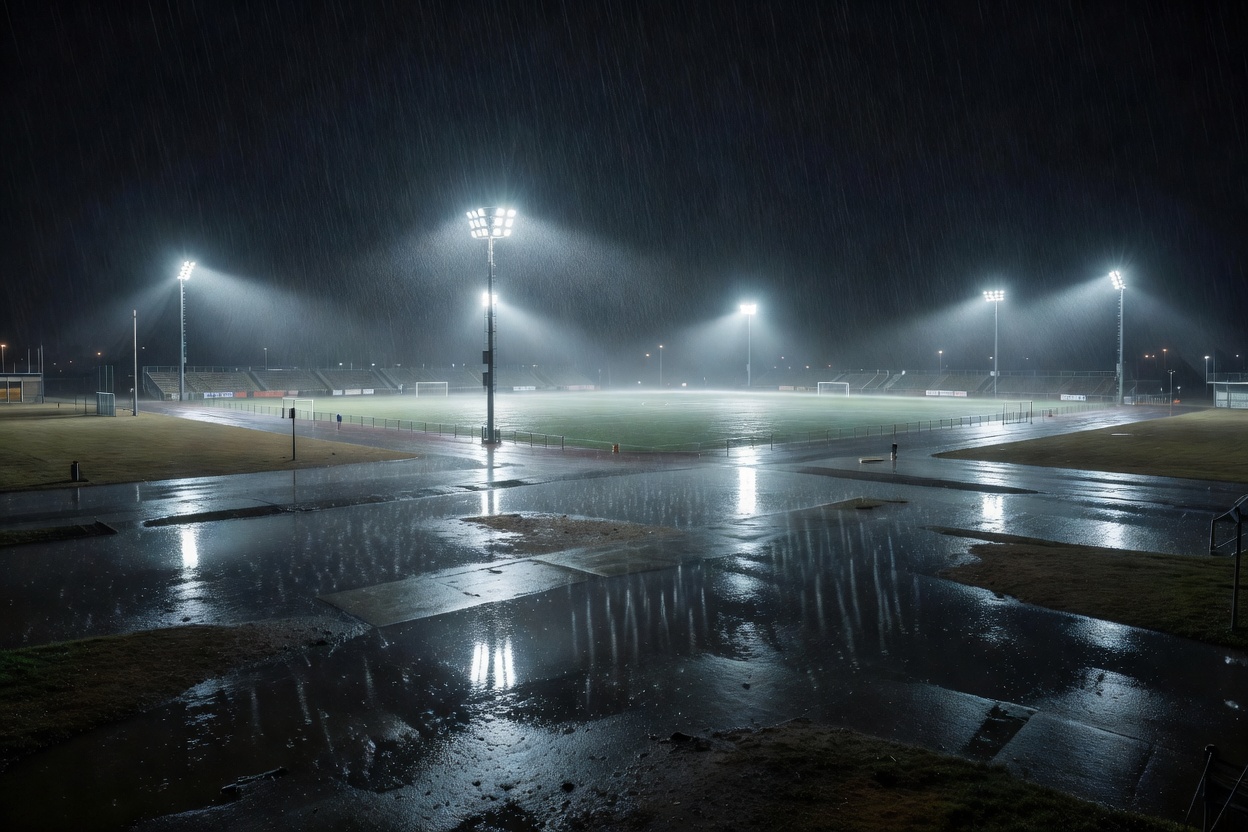
A venue is usually managed in departments: the pitch belongs to the grounds team, the concourses to facilities, the car parks to operations, the perimeter to security. Water ignores all of that. It arrives everywhere at once and travels according to levels, surfaces and whatever obstructions happen to be in the way that week.
Water management is largely about seeing the site the way the water sees it — as a continuous surface with high points, low points and routes between them — and then translating that back into decisions each team can act on.
The playing surface tends to receive the most investment and attention, but it does not exist in isolation. Water leaving the pitch has to be received by something, and the surround is where pitch drainage, stand run-off and event infrastructure all meet. Problems here are often mistakenly diagnosed as pitch problems.
Large impermeable areas shed water fast. On an event day they also carry dense pedestrian traffic, which makes standing water a genuine operational issue rather than an aesthetic one. Concourse drainage deserves the same seasonal attention the pitch gets.
The boundary strip between the built venue and the outside world often collects material from both: leaf fall and vegetation from one side, litter and silt from the other. It is also where drainage frequently transitions between systems, which makes it a common location for recurring issues.
Car parks, coach areas, delivery yards and emergency access routes are usually the largest surfaces on a site and among the least monitored. Because they carry vehicles, damage to covers and channels happens more often here, and because they are peripheral, that damage is noticed later.
Anywhere people queue is worth examining specifically. A shallow depression that is barely noticeable when the site is empty becomes a pinch-point problem when several thousand people are funnelling through it in the rain.
Before capacity questions, it is worth understanding direction. Where does water go when it leaves each surface? Does it reach a collection point, or does it travel across an area first? Are there places where two surfaces meet at slightly different levels and create an unintended pond? Walking the site during rainfall — safely, and with a note-taking habit — teaches more than any drawing.
Drainage capacity considerations follow from that. Any system has a limit, and that limit was set by assumptions made when it was built. Changes since then — additional hardstanding, a new structure, altered landscaping, a neighbouring development — may have moved the site past those assumptions. Site conditions should be assessed and applicable local requirements should be checked when capacity is in question.
A useful seasonal cycle typically involves pre-season checks of the whole system, intensified attention through leaf fall, heightened monitoring during the wettest months, and a post-season review of what actually happened. Preparation is about doing predictable work at a predictable time, so the unpredictable work is the only thing left to react to.
Where a venue chooses to incorporate weather into event planning, drainage information is one useful input among many: which areas are known to hold water, which alternative routes exist, where extra attention might be worthwhile the morning before. It is important to be clear about scope — drainage work supports water management, but it cannot guarantee that an event proceeds, prevent flooding in all conditions, or remove weather-related disruption. Decisions about events rest with the venue and its relevant authorities.
The most effective venues we work with have a very simple habit: someone writes down what happened. After heavy rain, a short note — location, what was observed, how long it lasted, what the weather had been doing — is circulated to whoever needs it. Over a season, those notes become the most valuable drainage document the venue owns.
On the provider side, the equivalent habit is reporting back in the same language and against the same location references, so that observations from different sources can be compared rather than argued about.
Looking at the venue as one water system makes it easier to spot upstream causes, prioritise sensibly and avoid spending on a symptom. It also gives different departments a shared vocabulary.
The limitation is that drainage is only one part of site water management. Ground conditions, surfacing choices, landscaping, neighbouring land, watercourse levels and rainfall intensity all contribute, and several of those are outside a venue's control. A whole-site view improves decisions; it does not remove risk.
RELATED SERVICES
Where the whole-site review identifies a structural gap, design input is the next conversation.
Stadium Drainage Design
Most of the actions from a water review land in the seasonal maintenance schedule.
Stadium Drainage MaintenanceIf different parts of your venue are tracked by different people, a single shared water picture is usually the fastest way to stop repeating the same conversation.